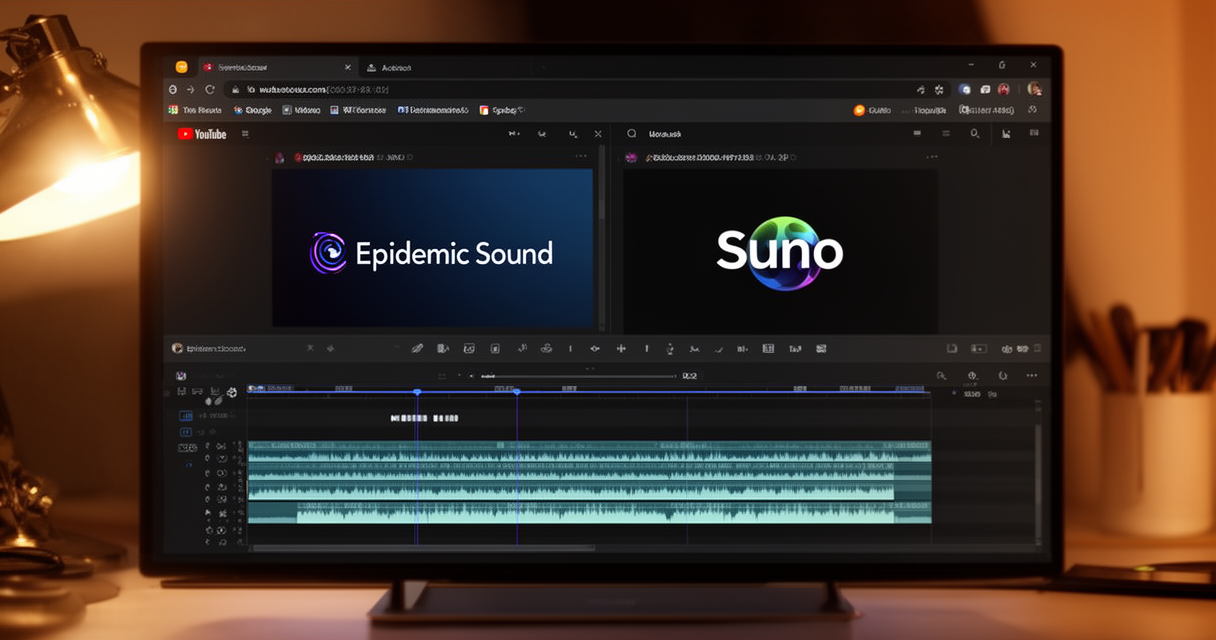
Your YouTube channel needs music. That much is settled. What isn’t settled is whether you should keep paying Epidemic Sound or switch to an AI generator like Suno — especially now that the legal ground under AI music has shifted dramatically.
The stakes are real. Pick the wrong option and you’re either overpaying for a library you barely use, or you’re sitting on a copyright time bomb inside your monetized videos.
The short answer: Epidemic Sound is still the safer, smarter choice for monetized content in 2026. But Suno Pro has earned a legitimate role in a hybrid stack — specifically for B-roll, intros, and scenes where Content ID exposure doesn’t matter. Running both costs you $17.99 per month, which is less than most creators waste on tools they open twice.
What You’re Actually Paying For
Let’s get the pricing straight before anything else, because the gap is smaller than you think.
Epidemic Sound (as of June 2026, annual billing):
- Creator: $9.99/month
- Pro: $16.99/month
- Business: $30/month
Suno (annual billing):
- Pro: $8/month (2,500 credits, roughly 500 songs)
- Premier: $24/month
At face value, Suno Pro at $8/month looks like a no-brainer upgrade over Epidemic Sound Creator. But that framing misses what you’re actually buying with each service.
Epidemic Sound gives you a cleared catalog — every track has been licensed for YouTube monetization, including revenue-sharing with the original artists. You upload a video, YouTube’s Content ID system sees the track, Epidemic Sound takes its content claim, and your monetization stays intact. The whole system is designed around that one guarantee.
Suno gives you generative output. You describe a vibe, it produces something. The ownership situation, however, is genuinely murky after the WMG settlement (more on that below). What you own — and whether that ownership holds up against a Content ID claim — depends heavily on how the label litigation shakes out.
The Copyright Situation Is Moving Fast
This is where creators are getting caught flat-footed.
In November 2025, Suno settled with Warner Music Group as part of WMG’s broader acquisition of Songkick. The settlement terms weren’t fully public, but it signaled that at least one major label was willing to work out a deal rather than litigate Suno into oblivion.
That goodwill did not extend to everyone. In May 2026, Universal Music Group and Sony expanded their lawsuit against AI music platforms to include 61,026 specific recordings. That’s not a warning shot — that’s a scorched-earth filing. The legal status of AI-generated music trained on major-label catalogs remains genuinely contested.
Meanwhile, Amuse stopped accepting Content ID registration for AI-generated music in 2026. That’s a distribution platform deciding the liability exposure isn’t worth it. YouTube has required disclosure for “Altered or synthetic content” since 2024 — meaning you’re already supposed to be flagging AI audio in your videos.
A pro producer testing Suno on r/WeAreTheMusicMakers put it directly: the WMG deal is interesting because of what it implies about ownership — if Suno’s training data included WMG recordings, does WMG have a derivative claim on outputs? The settlement didn’t answer that cleanly.
The honest read is this: for B-roll and scenes that will never run ads, the legal risk is low. For monetized hero content on a growing channel, you don’t want to test that theory.
What Reddit Is Actually Saying
The community consensus is more nuanced than the “Epidemic Sound is dead” hot takes suggest.
A creator in r/NewTubers who had been an Epidemic Sound subscriber for four years announced they were leaving — not because of pricing, but because of Epidemic Sound’s own AI Voices pivot. Their complaint: the platform that built its reputation on protecting creators was now using AI to generate voices without clear licensing terms, and that felt like a betrayal of the original value proposition. It’s a fair point. Epidemic Sound built trust on the “cleared for YouTube” promise, and any feature expansion that muddies that promise is worth watching.
On the flip side, multiple creators in r/youtubers noted that Suno’s catalog quality has improved enough that it’s genuinely usable for intros and background tracks — not professional quality, but “good enough for B-roll” is a real threshold for most creators. The 2,500 credits per month on Suno Pro (roughly 500 songs) is more music than any channel can actually use in a month.
The more sophisticated creators aren’t framing this as either/or. They’re asking: which tool for which use case?
The Hybrid Stack Case
Here’s the approach that actually makes sense for most independent YouTube creators in 2026.
Use Epidemic Sound Creator ($9.99/month) for:
- Any scene in a monetized video
- Background music in sponsorship segments
- Anything that will run YouTube ads
- Videos where a Content ID dispute would damage your channel
Use Suno Pro ($8/month) for:
- Intros and outros on non-monetized content
- B-roll filler on vlogs
- Shorts where you’re testing topics before investing in a polished video
- Channel trailers
Total monthly cost at annual billing: $17.99. That’s less than a single Epidemic Sound Pro subscription.
The logic is straightforward. Epidemic Sound’s value is its legal clearance — you’re paying for certainty, not just music. Suno’s value is its generative speed — you’re paying for volume and customization. These aren’t competing products. They solve different problems.
The one thing to get right with this stack: never cross the streams. Suno-generated audio in a monetized video is where things get complicated. Keep the use cases clean.
Our Take: The Platform Loyalty Question Is Worth Asking
The r/NewTubers complaint about Epidemic Sound’s AI Voices feature deserves more attention than it’s getting.
Epidemic Sound built its entire creator-market positioning on one idea: we are the safe choice. You pay us, we handle the licensing, you focus on making videos. That promise justified a premium over royalty-free alternatives for years.
The AI Voices pivot complicates that. If Epidemic Sound is now generating AI voices from voices that weren’t explicitly licensed for AI training — which is the same accusation being leveled at Suno — then the moral authority Epidemic Sound used to distinguish itself gets thinner. A creator in r/podcasting made this exact point: the line between “AI music” and “AI voice acting” is arbitrary if both involve training on human performances without explicit consent.
We still think Epidemic Sound is the right call for monetized content. The legal clearance on the existing music library is real, established, and battle-tested. But if Epidemic Sound’s product roadmap leans further into AI generation, the pricing premium gets harder to justify relative to tools that are honest about what they are.
Watch the next 12 months. If UMG/Sony’s expanded lawsuit produces a clear ruling, the entire AI music distribution ecosystem changes overnight. That’s not a prediction — it’s a risk you should be pricing in now.
For a broader view of how YouTube is treating AI-generated content across categories, see our breakdown at YouTube AI monetization policy 2026.
When to Switch to Suno Entirely
There are specific situations where going all-in on Suno (or another AI generator) is defensible.
You’re building a non-monetized audience. If your channel is a top-of-funnel for a service business and you never plan to run YouTube ads, Content ID exposure costs you almost nothing. Suno Pro at $8/month is a reasonable choice.
You publish high-volume Shorts. At 500 songs per month, Suno Pro generates more music than you can use. If you’re publishing daily Shorts and burning through music quickly, the cost-per-track math favors Suno heavily.
Your content is experimental. Testing new formats on a secondary channel? Suno’s speed — generate a track in seconds from a prompt — beats spending time browsing Epidemic Sound’s catalog. Save the cleared library for the content you’re committing to.
What you should not do: cancel Epidemic Sound on your main monetized channel because Suno is cheaper. The dollar difference doesn’t justify the risk exposure on revenue-generating content.
Frequently Asked Questions
Does Suno music pass YouTube’s Content ID system?
Currently, most Suno-generated tracks don’t trigger existing Content ID claims because they’re novel outputs. But if UMG/Sony’s lawsuit establishes that AI outputs are derivative works of training data, that could change retroactively. Additionally, Amuse’s 2026 decision to stop registering AI music with Content ID signals that distribution platforms see increasing liability. Don’t assume a clean track today means a clean track in 12 months.
Do I have to disclose AI-generated music on YouTube?
YouTube’s “Altered or synthetic content” disclosure requirement has been mandatory since 2024 and applies to audio. If you’re using Suno or any AI-generated music, you should be checking the disclosure box when uploading. The policy is about transparency to viewers, not a monetization gate — but failure to disclose can trigger strikes.
Is Epidemic Sound Creator enough or do I need Pro?
For most solo YouTube creators, Creator at $9.99/month is sufficient. The Pro tier adds commercial use for brand clients and team access. If you’re running a video production business or creating content for clients, Pro is worth it. If it’s your own channel, Creator covers you.
Can I use AI music for YouTube Shorts monetization?
YouTube’s Shorts monetization program follows the same Content ID rules as long-form content. AI-generated music sits in a gray zone — it likely won’t trigger existing Content ID claims today, but the legal landscape is actively shifting. Cleared libraries like Epidemic Sound are the conservative choice even for Shorts.
What happens to my videos if Suno loses the UMG/Sony lawsuit?
This is the scenario nobody wants to think through. If a court rules that AI outputs trained on major-label catalogs are derivative works, YouTube could be required to remove or demonetize videos containing that audio retroactively. The practical outcome is unknown, but it’s a reason to keep cleared-library audio on your most important videos.
The Decision Is Simpler Than the Debate
Epidemic Sound for monetized content. Suno Pro for everything else. $17.99/month total.
The legal drama around AI music is real and unresolved — the UMG/Sony expansion to 61,026 recordings isn’t a niche story, it’s a potential restructuring of how AI audio gets distributed and licensed. You don’t need to pick a side in that fight. You just need your channel to stay clean while it plays out.
Cancel Epidemic Sound only when you have a specific reason to, not because a cheaper tool exists. The premium you’re paying is for certainty, and certainty is worth something when your channel revenue is on the line.
Your music stack is one piece of the creator AI toolkit. If you’re also sorting out AI voice tools for narration, we covered the landscape in ElevenLabs vs Murf for content creators 2026. And if you want to optimize the videos that actually use all this music, our take on VidIQ vs TubeBuddy in 2026 covers the channel growth side.